Cuts to Liberal Arts in State of Virginia 2017
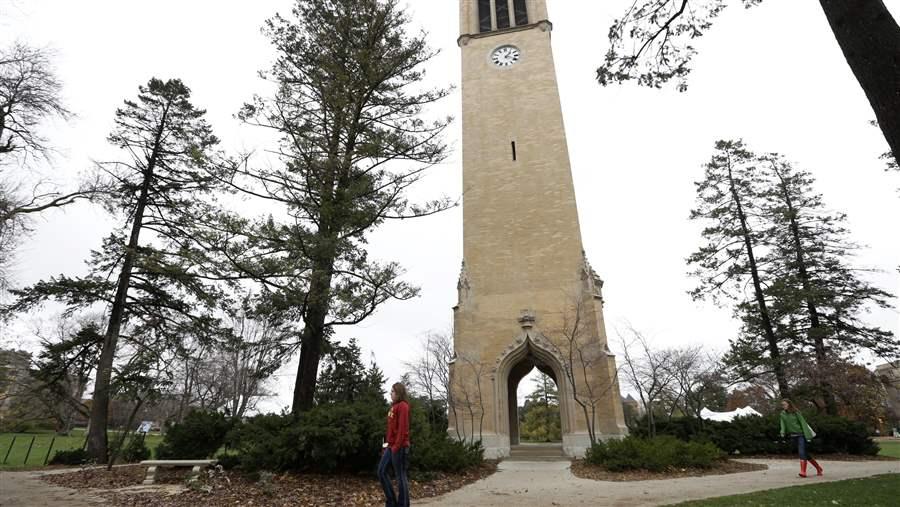
Students walk past the campanile at Iowa State University. Iowa State is among the universities that charge higher tuition to students in certain programs.
© The Associated Printing
Tuition prices listed on college websites have long been divorced from what students actually pay. The students strolling through campus pay very different amounts depending on their financial assistance awards.
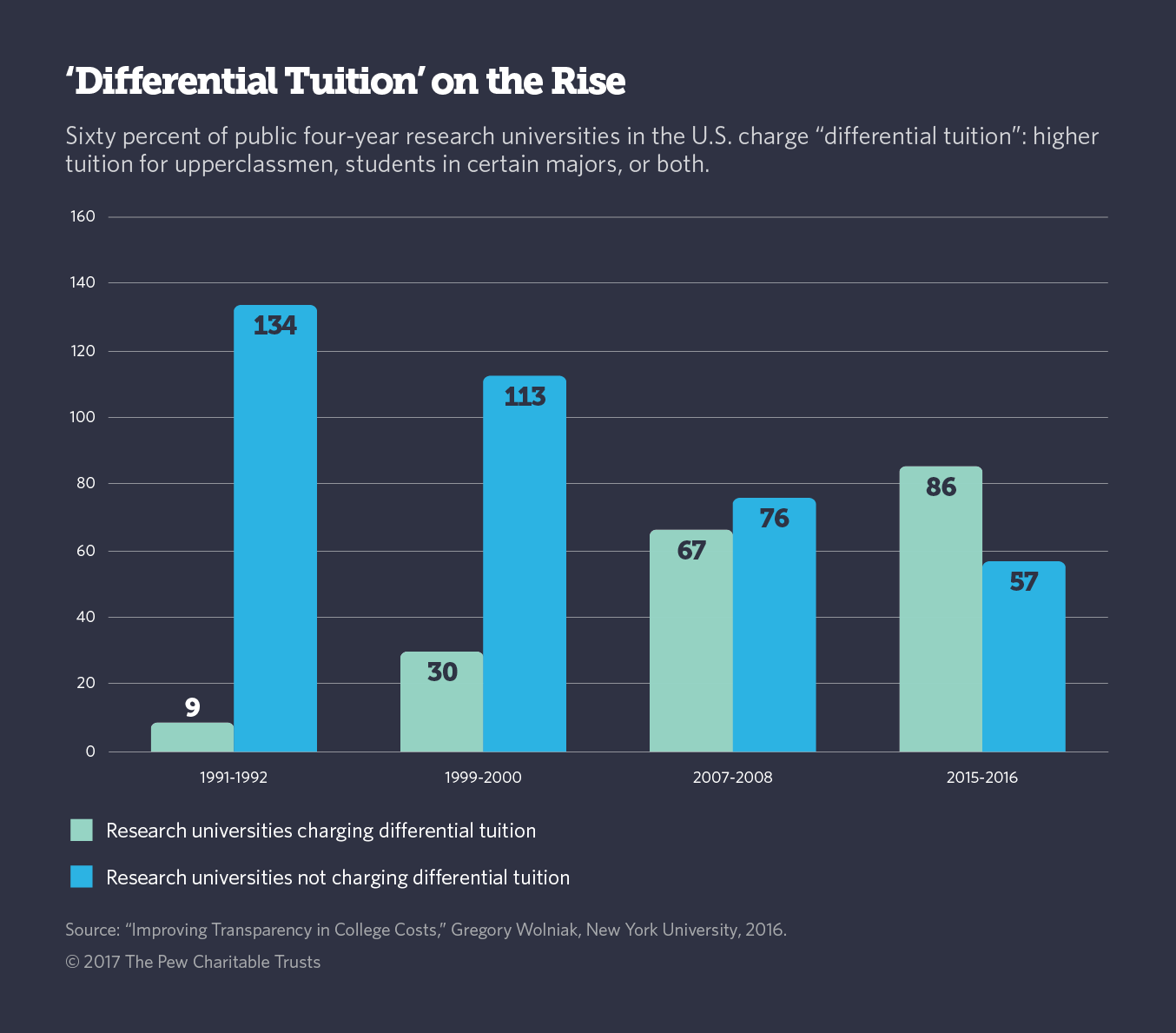
But recently, many colleges have added a new complication: Sixty percent of public research universities now assess tuition based on students' year of study, major, or both, according to an upcoming report led by Gregory Wolniak, a research director at New York University.
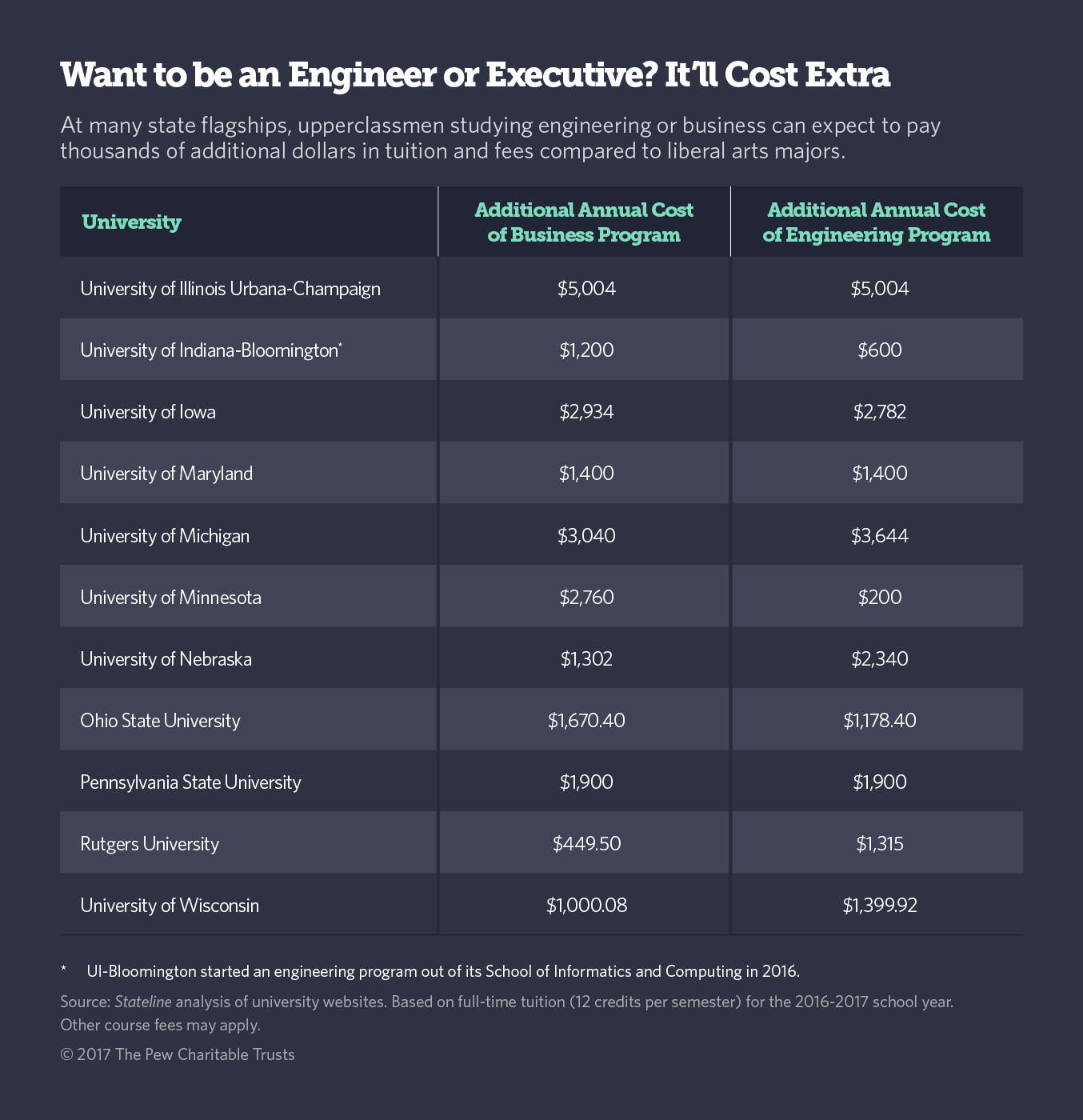
At the University of Illinois at Urbana-Champaign, for example, undergraduates in the College of Business were charged 42 percent higher in-state tuition — about $5,000 more — last year than undergraduates studying, say, English. Art students paid an additional $1,600, not counting additional fees to encompass the price of art supplies in certain classes. Even journalism majors have to kick in an extra $780 in tuition.
Universities say they need the boosted money to cover the cost of expensive programs. And in some states, governors take encouraged and then-called differential tuition, or program fees, as alternatives to across-the-board tuition increases.
But other policymakers and advocates for students worry that surcharges will bulldoze immature people away from subjects important to the state economy, or shut low-income students out of majors that lead to lucrative jobs.
"Nosotros're trying to produce more [science, engineering, engineering and mathematics] degrees and raising the price would be a disincentive," said and then-Maryland Gov. Martin O'Malley, a Democrat, in 2012, criticizing the Academy of Maryland'due south request to heighten the cost of some science and engineering science programs. The academy and its Board of Regents canonical increases for engineering, business and computer science programs three years later.
Information technology's hard to say if differential pricing is changing students' decisions. Officials at universities that have differential tuition say their more expensive programs are every bit popular as ever. And as Wolniak's enquiry team found, information about higher tuition and additional fees isn't always clearly communicated, so that students and parents might not know near it.
The six graduate students on his research team, who scoured university websites for tuition information, often reached dissimilar conclusions for the aforementioned university. Sometimes notice of a programme fee would show upward in the footnotes of a PDF file on the bursar's office website. Some universities only provide cost information past credit hour.
"Things should non be this opaque," Wolniak said.
Expensive Programs
In 2015, 86 of 143 public research universities had a differential tuition policy, Wolniak and his colleagues at Arizona State University and the University of Louisville constitute. Dorsum in the early 1990s, just nine institutions did. In the working newspaper they're circulating, the researchers say differential tuition is specially mutual in the Midwest.
A survey conducted by Cornell researchers in 2011 found that universities most often charge more for business, engineering and nursing programs.
Stateline took a closer look at the flagship public universities in the Large 10 Briefing and establish that all of them charge college tuition or program fees to in-state upperclassmen studying engineering science and business than to in-country upperclassmen studying liberal arts.
The math doesn't include fees for individual courses, which make calculating the real cost even more complicated. For example, at the University of Michigan, freshmen and sophomores spend $1,000 more than per yr to study engineering than to study film, and juniors and seniors pay $3,644 more.
Just many moving picture studies classes accept a fee attached, such as a course in writing feature-length screenplays ($150) and a dramatic narrative course that gives students access to loftier-tech flick production equipment ($200). Depending on the classes they have, motion picture students could end upward paying hundreds of dollars more than the posted cost.
Academy officials give a simple reason for why they charge additional tuition to students in some majors. "Certain majors and programs are only more expensive to provide than others," said Sue Curry, University of Iowa interim executive vice president and provost.
Engineering science classes require specialized equipment, for instance. Business and figurer science kinesthesia expect salaries comparable to the private sector. Small class sizes are a must in nursing programs. And coordinating internships and clinical experiences takes a lot of university resources.
The University of Iowa charges college tuition to undergraduates enrolled in the Colleges of Nursing, Business and Engineering than it does to liberal arts students. (Undergraduates in the Carver Higher of Medicine pay the same tuition merely lower fees than liberal arts students.)
And business organization and engineering students pay fifty-fifty higher prices as upperclassmen, when they're enrolled in more intimate, advanced classes. Curry said the pricing makes sense considering students who pay extra are taking classes that cost the university more. She also noted that graduates of the 3 more expensive programs typically go on to make practiced money.
Former Virginia Gov. Bob McDonnell encouraged universities to adopt differential tuition during his time in office, from 2010 to 2014. "Using some basic market and economic principles, this approach makes sense," the Republican said in an email. "If it costs more to produce the degree, and your earning potential when you get out is more, pregnant you lot can pay off tuition debt faster, then the value of the degree, purely in financial terms, is greater."
Falling State Funding
Falling land funding, which has pushed upwards tuition nationwide, has influenced many universities' decision to accuse more than for certain programs.
In Iowa last year, less-than-expected state funding led the university organisation and Board of Regents to approve a 2 percent tuition increase for in-state students and increases for out-of-state students that varied depending on the university. The board approved even larger tuition increases for many of the eight programs beyond the iii universities that already had differential tuition.
The board besides approved higher prices for upperclassmen in five boosted programs at Iowa State: beast scientific discipline, biology, computer science, industrial design, and natural resource and environmental management. Iowa Country already charged extra to compages students and upperclassmen studying business, applied science, agriculture systems technology and industrial technology.
The tuition increases will be reinvested in the programs — to buy livestock for the beast science plan, for instance, university officials say.
Administrators wanted to aggrandize differential tuition because they were concerned that falling funding — combined with eight years of enrollment increases — would lead to lower-quality programs, said Jonathan Wickert, senior vice president and provost at Iowa State.
"We are an institution with very economical and affordable tuition. That's important to united states," he said. "But at the same time, we want to balance that affordability with the quality of the program."
Wickert and his squad met with students to discuss the new pricing. They pointed out that Iowa State tuition would remain lower than its peers and shared data on program toll. In biology, for instance, about 40 per centum of class time is spent in laboratories, which require professional staff to maintain.
Cole Staudt, who served as Iowa Country's educatee body president terminal yr, wasn't a fan of the decision to charge more for certain majors. He preferred an earlier idea floated by the university president: to charge all upperclassmen a little more than.
"Nosotros don't want students who come up to Iowa Land — or come up to college in general — who are low-income, or first-generation, and can barely afford to come to college in the beginning place, to cull a major based on cost," Staudt said. If merely affluent students can afford the expensive majors at Iowa State, and those majors all atomic number 82 to college-paying jobs, that simply perpetuates inequality, he said.
And so-Gov. Terry Branstad, however, had a different worry. "My business organisation is that a lot of our students are starting out at the community colleges because they can't afford to get to the state universities," the Republican told reporters concluding September. "We don't want to penalize them by having college tuition for them in their junior and senior years."
Effect on Students
State lawmakers have long used financial incentives to encourage students to enter certain programs. Arkansas and Georgia offer grants to students enrolled in 2-year programs associated with jobs local employers need to fill up, mostly in STEM fields. In 2012, Florida Gov. Rick Scott, a Republican, suggested cutting tuition charged to Stem majors at state universities.
Meanwhile, at many state universities, fields similar informatics and technology are becoming more than expensive.
Advocates for low-income and minority students take criticized differential tuition, proverb that even a modest tuition or fee increase tin go out students scrambling to pay for school. At four-twelvemonth colleges, which are already expensive, "whatever boosted price you accept on absolutely has an impact," says MorraLee Keller, director of technical assistance at the National College Admission Network.
Keller said that the more than toll information gets broken down by programme and past grade, the harder it is for families to figure out the toll. "There's a possibility that you'll but discover out when your bill arrives," she said, peculiarly if the data isn't easy to observe online, or clearly communicated by a college admissions officer or high school guidance counselor.
Few researchers have studied differential tuition's consequence on students. A 2013 statistical analysis by University of Michigan researcher Kevin Stange suggests that raising the cost of an engineering science program may lower the number of women and minority students who enroll. The bear upon on business programs and nursing programs was close to nix.
University leaders say differential tuition hasn't injure their enrollment or graduation rates. In fact, Iowa State's Wickert said that since the university raised engineering tuition in 2005, the program's popularity has soared. "One in four students on our campus is studying technology, perhaps because of differential tuition that has built the quality of the program," he said.
Business is the near popular bachelor's degree in America, according to federal statistics. Wellness professions are the 2nd most popular. From 2008 to 2014, the number of applied science degree awards shot up past 29 per centum.
Students and families are often willing to pay more for a program with a good reputation. That gives universities elbowroom to raise tuition. "In that location's no dubiousness that institutions are trying to charge what the market place will allow them to charge," said David Strauss, principal at the Fine art & Science Grouping LLC, a higher teaching consulting firm.
Savvy students may exist able to game a differential tuition arrangement — declaring one major, taking a bunch of courses exterior it, and then switching at the terminal minute, said Staudt, Iowa State'due south former educatee trunk president. "Another statement we put frontward is — where does it stop?" he said. Given the state'southward budget situation, he said, dissimilar strategies for raising tuition volition likely go along to be discussed.
Source: https://www.pewtrusts.org/en/research-and-analysis/blogs/stateline/2017/06/01/why-universities-charge-extra-for-engineering-business-and-nursing-degrees
0 Response to "Cuts to Liberal Arts in State of Virginia 2017"
Post a Comment