What Type of Arts Do Israel Value What Type of Arts Does Israel Have
Ancient Israelite art traditions are evident peculiarly on stamps seals, ivories from Samaria, and carvings, each with motifs connecting it to more full general artistic traditions throughout the Levant. Ancient Israel, and therefore its art, existed from about the tenth century BCE until the late 8th century BCE and used both local and imported materials, as demonstrated past local limestone used for stamp seals and carved ivories that were possibly imported from Phoenicia. Common motifs in aboriginal Israelite art include plants flanked by animals, astral symbols (such as sun-disks and stars), adjusted forms of Egyptian symbols (such equally winged sphinxes, uraei, and falcons), various animals (such as lions, ostriches, and bulls), and monsters (such as Cherubs - creatures akin to the Lamassu).
As with most art in the aboriginal world, it is not clear who created the fine art, fifty-fifty in cases of stamp seals which may take been created by someone other than the ane who is named on the seal. Besides, due to the age and preservation of art from ancient State of israel, information technology is not exactly articulate how or where objects were manufactured; oftentimes, suggestions are educated guesses. In whatsoever example, whether we consider intricate ivories discovered in Samaria - the upper-case letter of Israel - or detailed stamp seals, Israelite materials and objects tell stories nearly society two,700 years ago. Art reveals many aspects of the Kingdom of State of israel: ongoing merchandise of luxury items amongst the upper course; perspectives on cult rituals, deities, and sacred objects; international networks; cultural concerns; and the function of cults and deities in ancient Israel.
Materials, Techniques, & Their Makers
The ivory pieces from Samaria evidence a wide diversity of imagery & cultural influence, especially Egyptian, Phoenician, & North Syrian.
Just mod artists choose dissimilar canvases and materials with which to work (e.g., clay figurine, wall, newspaper, etc.), so artists of ancient Israelite fine art used various materials. For example, limestone was used most ofttimes to create stamp seals, though other materials, such as semi-precious stones (carnelian, jasper, quartz, etc.), bone, dirt, and ivory, were used, albeit less oft. To create the postage seal, lapidaries (artists who work with stone) would shape the sail material into a shine, scaraboid shape, measuring between 8 mm and 3 cm long. Though less common, conical, hemispheroid, and circular postage stamp seals were also used in ancient Israel. Subsequently creating a polish, polished canvas, creators would inscribe designs into the seals through multiple methods: engraving images and words with a precipitous, pointed tool; filing the border of the stone; using a boring tool perpendicular to the seal; or wheel-cutting, "cutting with the head of a tool spinning parallel to the surface" (Seevers and Korhonen 2016). Ancient Israelite art is non particularly unique, though, and observations regarding materials and techniques also apply art in the broader Levant during the Atomic number 26 Age.
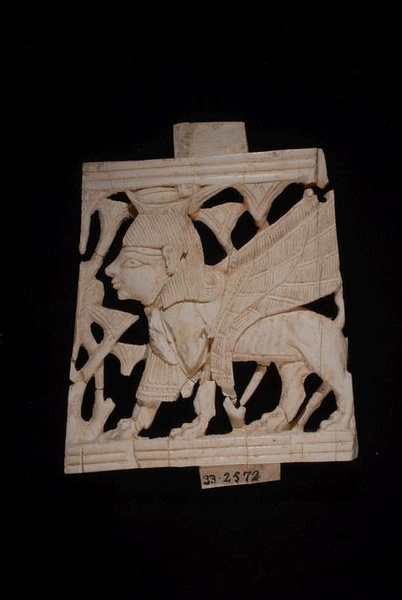
Ivory Furniture Inlay with Sphinx
Though ivories were discovered in Samaria, they were also common luxury items throughout Northern Syria. As such, ivories were carved and produced throughout the region, sometimes with multiple production centers throughout single cities. In order to create ivory carvings, a combination of tools was used: saws, broad- and pointed-edge chisels, flat chisels, bow drills, and other variations of these tools. Much remains to be learned, though, as our understandings come from informed inferences such as this description:
... the bulk of ivory around the sculptural forms of the cow and calf was likely removed using a combination of paw-powered drills, such as a bow-drill, and chisels. A like combination may also have been used to create the deep recesses for the optics of the cow and calf. (Lauffenburger, Anderson-Zhu, and Gates 2018)
Samarian Ivories: Luxury & Power
In the ancient Near East, ivory was a highly valued detail. Ivory workshops existed throughout Due north Syria, which Samaria was a function of. Both biblical texts and archaeological prove attest to the importance of ivory carving in the kingdom of State of israel. For example, the Hebrew Bible refers to ivory houses that Yahweh will destroy (Amos iii:17). Supporting the Hebrew Bible's indication that carved ivories were important in the Kingdom of Israel, archaeologists recovered almost 500 fragments of ivory art from Samaria in the 20th century CE. The ivory pieces show a broad variety of imagery and cultural influence, peculiarly Egyptian, Phoenician, and N Syrian.
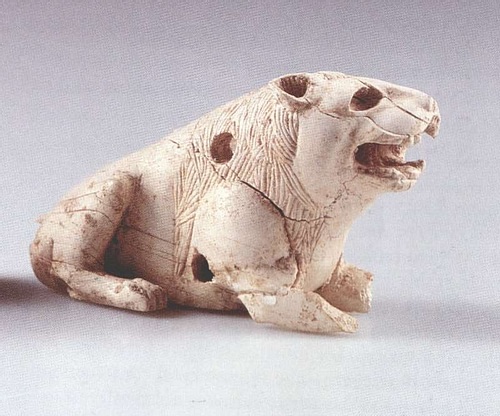
Crouching Panthera leo Furniture Inlay, Samaria
Consider, for example, ivory carved, crouching lions, uncovered at Samaria in the 1930s CE. Various scholars translate these carvings as furniture inlays, meaning they were used to decorate the surface of furniture. Remarkably similar objects were uncovered at Sam'al (mod Zincirli) and Thasos (in the Aegean Sea). Every bit early as the 1930s CE, scholars causeless the close relationship between art forms, like the crouching lions, meant that State of israel imported ivory carvings from around the region, such as Damascus and Phoenicia. Though plausible, this is difficult to ostend.
Similarities between Samarian ivories and other sites in northern Syrian (e.m., Arslan Tash, Nimrud, Zincirli, etc.) can be a window into the social function of art. Textual evidence from the 9th century BCE indicates that the Kingdom of State of israel and diverse other groups in the region formed a coalition to oppose Neo-Assyria. Presumably, forming a coalition would have involved visiting and hosting foreign leaders. In visiting strange leaders, luxury items - similar ivory carvings - would indicate to visitors State of israel's wealth and, thereby, its ability. Merely as luxury items in the 21st century CE indicate social status, artwork in the Kingdom of Israel functioned every bit a point to the viewer - whether foreign dignitary or commoner - that the King of Israel had power, wealth, and could afford luxury items, these were indicative of the kingdom's prestige in relation to places like Phoenicia, Nimrud, and Damascus.
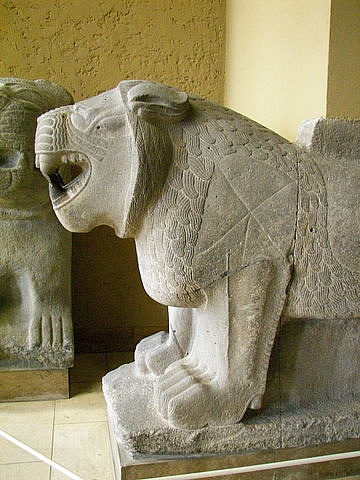
Sam'al Lion
Stamp Seals: Politics, Religion, & Networks
Stamp seals are objects typically inscribed with a name and artwork. To identify and authenticate other objects, people would press the postage stamp seal into wet clay. Likewise, stamp seals were used for clay envelopes, ensuring that messengers or other parties did not superlative at the document. Notably, though, there is bully variety in stamp seals from the Kingdom of State of israel, indicative cultural influences, political networks, and religious ideas.
The increase in localized postage seal styles by the ninth century BCE parallels increased urbanization & centralization in ancient Israel.
Early on, Egyptian art heavily influenced the Levant. By the middle of the 2nd millennium, about 1500 BCE, nearly twoscore% of stamp seals represented scarab beetles. While some of these were produced in Egypt, it is likely that scarabs were also produced in State of israel. For instance, some postage stamp seals combine the Egyptian element, a scarab beetle, with not-Egyptian motifs, "such as the frontal depiction of a nude female, who may stand for a goddess related to the fertility of plants and animals" (Eggler and Uehlinger, 16). Likewise, some postage stamp seals blend Egyptian and Canaanite deities, such every bit "the delineation of a wined god battling against a horned ophidian or standing on a lion" (Eggler and Uehlinger, sixteen). Egyptian art styles mixed significantly with Canaanite postage stamp seals prior to the Atomic number 26 Age and the emergence of aboriginal Israel.
Equally Egyptian power in the Levant waned around the 12th and 11th centuries BCE, scarab stamp seals were produced far less frequently. Instead, local seal traditions distinguished themselves from the heavy influence of Egyptian culture, producing conoid and high-domed stamps out of limestone (previously, seals tended to be made of a material chosen enstatite). Additionally, more than localized art became prominent, such as caprids flanking a tree or suckling animals. By the 9th century BCE, the increasing prominence of local symbols and images throughout the Levant are indicative of "the gradual rising and consolidation of local and/or regional chiefdoms… and formalized exchange patterns" (Eggler and Uehlinger, sixteen). Notably, the increase in localized postage seal styles by the 9th century BCE parallels increased urbanization and centralization in aboriginal Israel.
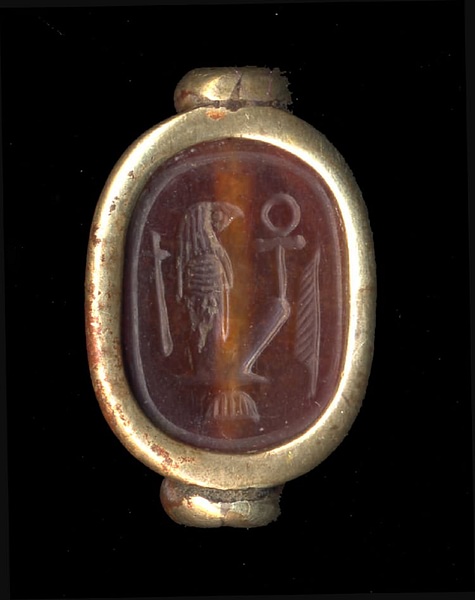
Phoenician Scarab Seal
From the mid-9th century BCE onward, stamp seals throughout the region constituted a sort of mutual language, "displaying such commonly recognized auspicious or apotropaic entities equally winged sphinxes, uraei, falcons, sun-disks, etc." (Eggler and Uehlinger, 17). Though of Egyptian origin, such art on postage seals indicates a distinct Syro-Phoenician character, not an attempt to synchronize Egyptian elements with local forms. Furthermore, stamp seals from the mid-ninth century BCE until the devastation of Israel contain more name and title inscriptions than previous time periods.
Alongside the imagery, stamp seals with names typically included a group of the following elements: owner's personal proper name, the phrase "daughter of" or "son of," the name of the father, and occasionally an occupational championship. For instance, one seal from State of israel translates "Belonging to Shema, servant of Yarobam" (Heb. לשׁמע עבד ירבעם). Between the words "belonging to Shema" and "servant of Yarobam" is a lion facing left. Of course, because the Northern Kingdom of Israel was destroyed effectually 721 BCE, Israelite postage stamp seals ceased to exist, and they no longer played a role in regional politics.
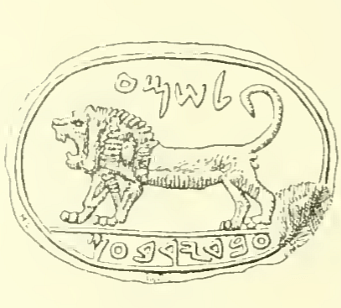
Seal of Shema, Servant of Jereboam
Image in Israelite Religion: Representations of Yahweh
Archaeological and biblical sources are exceedingly clear: Yahweh played a fundamental function in ancient Israelite religion. That is, although Israelites recognized the reality of other deities, they were perceived every bit existence less powerful than Yahweh. What is unique to Israel, though, is how they represented Yahweh in art, or rather, how they did not.
In ancient Israelite art Yahweh is non represented anthropomorphically.
Throughout Syria after the 10th century BCE, anthropomorphic representations of deities became less mutual. That is, deities were non represented like humans every bit oftentimes as before. Rather than representing deities equally humans, artists regularly represented them as animals (bull, horse, caprid), natural entities (tree), or astral symbols (crescent moon, sun deejay). For State of israel, this implies that they did not create images of Yahweh equally a mighty warrior, fertility, or storm deity; rather, animals or astral symbols may have symbolized the deity. Referring to the Israelite postage stamp seal in the previous department, the lion may symbolize Yahweh; however, the lion may also symbolize a wide variety of other things: kingship, the possessor of the seal as mighty, an apotropaic image, and more. We have no fashion to confirm. What we know for sure, though, is that in ancient Israelite art Yahweh is not represented anthropomorphically.
Ritual, Cult, & Art in Israel
Another significant identify where fine art appears in ancient Israel is in cult areas. Ane of the almost famous artistic artifacts related to an Israelite cult is a cultic stand up from Taanach. Standing at almost 1 meter tall, it has iv tiers and a roof. Each tier contains religiously inflected art. For example, the tertiary tier contains two caprids facing and climbing a stylized tree; the tree symbolizing a goddess or fertility. Also, the everyman tier contains what historians Othmar Keel and Christoph Uehlinger call the "Mistress of the Lions," influenced past Phoenician art and reflecting the worship of a goddess (157).
Interestingly, the 2nd tier contains "only a pair of cherubs and a space and no depiction is missing between them… The space appears to have been left empty intentionally" (Keel and Uehlinger, 157). Because Cherubs (Hebrew plural cherubim) were considered divine guardian creatures, two possibilities could explain the blank space. Commencement, the bare space could be emblematic of an "invisible deity." Every bit previously mentioned, anthropomorphic representations of deities decreased in the 10th and 9th centuries BCE. Such an interpretation of the bare space is reminiscent of biblical texts. In Exodus 25:19-22, Cherubs are fastened to the top of the ark. The ark is representative of Yahweh'due south footstool. Notwithstanding, Yahweh is not represented past any prototype. Thus, there is a resemblance betwixt the representation of Yahweh in biblical texts and Israelite art.
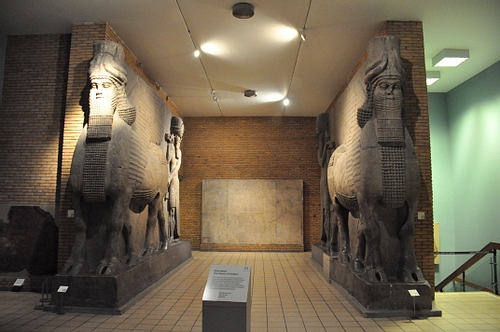
Human being-Headed Winged Bulls and Genies from Khorsabad
Another interpretation is that the Cherubs flanking blank space is symbolic of Cherubs guarding the archway to a shrine. Similar notions are evident in Neo-Assyrian art and architecture, where the massive Lamassu guarded the archway into the rex'southward palace. In determination, whether the art represented Yahweh as an "invisible deity" or the archway to a shrine, Israelite art was clearly used to enrich cult contexts, the symbols of divine entities and images carrying a caste of sacredness and communicating to the audition, demarcating the surface area as sacred, and creating a space for Israelites to practice their religious rituals.
Conclusion
The Kingdom of Israel created and received fine art as part of social activity. Though their art forms and motifs were not particularly unique in and of themselves, what was unique is how the art was used to bolster ancient Israel's legitimacy in relation to other powers. Israel displayed fine art to demonstrate its power (Samaria ivories), participate in regional politics (stamp seals), limited religious ideas, and create sacred spaces for cultic rituals. Simply put, the Kingdom of Israel used fine art in order to communicate ideas amid themselves and to others.
This commodity has been reviewed for accuracy, reliability and adherence to academic standards prior to publication.
Source: https://www.worldhistory.org/Israelite_Art/
0 Response to "What Type of Arts Do Israel Value What Type of Arts Does Israel Have"
Post a Comment