what change to policing resulted from miranda v. arizona
| Miranda v. Arizona | |
|---|---|
 Supreme Courtroom of the Us | |
| Argued February 28 – March 1, 1966 Decided June 13, 1966 | |
| Full case name | Miranda five. State of Arizona; Westover v. U.s.; Vignera v. Land of New York; State of California v. Stewart |
| Citations | 384 U.S. 436 (more) 86 S. Ct. 1602; sixteen L. Ed. 2d 694; 1966 U.S. LEXIS 2817; 10 A.L.R.3d 974 |
| Statement | Oral argument |
| Example history | |
| Prior | Defendant . Superior Ct.; affirmed, 401 P.2nd 721 (Ariz. 1965); cert. granted, 382 U.Due south. 925 (1965). |
| Subsequent | Retrial on remand, defendant convicted, Ariz. Superior Ct.; affirmed, 450 P.2d 364 (Ariz. 1969); rehearing denied, Ariz. Supreme Ct. March xi, 1969; cert. denied, 396 U.Southward. 868 (1969). |
| Belongings | |
| The Fifth Amendment right against self incrimination requires police force enforcement officials to advise a suspect interrogated in custody of their rights to remain silent and to obtain an chaser, at no charge if need be. Supreme Courtroom of Arizona reversed and remanded. | |
| Courtroom membership | |
| |
| Case opinions | |
| Bulk | Warren, joined past Black, Douglas, Brennan, Fortas |
| Concur/dissent | Clark |
| Dissent | Harlan, joined by Stewart, White |
| Dissent | White, joined by Harlan, Stewart |
| Laws applied | |
| U.S. Const. amends. V, VI, XIV | |
Miranda v. Arizona , 384 U.S. 436 (1966), was a landmark decision of the U.S. Supreme Court in which the Court ruled that the 5th Subpoena to the U.Southward. Constitution restricts prosecutors from using a person's statements fabricated in response to interrogation in police custody as evidence at their trial unless they tin show that the person was informed of the right to consult with an attorney before and during questioning, and of the right against self-incrimination earlier police questioning, and that the defendant non only understood these rights, only voluntarily waived them.
Miranda was viewed by many as a radical change in American criminal police, since the Fifth Subpoena was traditionally understood but to protect Americans against formal types of compulsion to confess, such as threats of contempt of courtroom.[1] Information technology has had a significant bear upon on law enforcement in the United States, by making what became known as the Miranda warning part of routine police procedure to ensure that suspects were informed of their rights. But the concept of " Miranda warnings" speedily defenseless on across American law enforcement agencies, who came to phone call the practice "Mirandizing".
Pursuant to the U.S. Supreme Court determination Berghuis v. Thompkins (2010), criminal suspects who are enlightened of their right to silence and to an attorney, simply choose not to "unambiguously" invoke them, may notice any subsequent voluntary statements treated as an implied waiver of their rights, and used as or as part of prove. At least ane scholar has argued that Thompkins effectively gutted Miranda.[2]
Background [edit]
Legal [edit]
During the 1960s, a motility which provided defendants with legal assist emerged from the collective efforts of various bar associations.
In the ceremonious realm, it led to the creation of the Legal Services Corporation nether the Great Society programme of President Lyndon B. Johnson. Escobedo 5. Illinois, a case which closely foreshadowed Miranda, provided for the presence of counsel during police interrogation. This concept extended to a business concern over police force interrogation practices, which were considered by many[ who? ] to be barbaric and unjust. Coercive interrogation tactics were known in menses slang as the "third degree".[ commendation needed ]
Factual [edit]
.[three] "[4]
was he informed that his statements during the interrogation would be used against him. At trial, when prosecutors offered Miranda's written confession equally evidence, his courtroom-appointed lawyer, Alvin Moore, objected that because of these facts, the confession was not truly voluntary and should exist excluded. Moore's objection was overruled, and based on this confession and other evidence, Miranda was bedevilled of rape and kidnapping. He was sentenced to xx–30 years of imprisonment on each charge, with sentences to run concurrently. Moore filed Miranda's appeal to the Arizona Supreme Court, claiming that Miranda'southward confession was not fully voluntary and should not have been admitted into the court proceedings. The Arizona Supreme Court affirmed the trial court's decision to acknowledge the confession in Land v. Miranda, 401 P.2d 721 (Ariz. 1965). In affirmation, the Arizona Supreme Court heavily emphasized the fact that Miranda did non specifically request an attorney.[5]
Chaser John Paul Frank, old constabulary clerk to Justice Hugo Blackness, represented Miranda in his appeal to the U.Due south. Supreme Court.[6] Gary Yard. Nelson represented Arizona.
Supreme Court decision [edit]
On June thirteen, 1966, the Supreme Court issued a 5–iv decision in Miranda's favor that overturned his conviction and remanded his case back to Arizona for retrial.
Stance of the Courtroom [edit]

Five justices formed the bulk and joined an stance written by Chief Justice Earl Warren.[7] The Courtroom ruled that because of the coercive nature of the custodial interrogation by police (Warren cited several law training manuals that had non been provided in the arguments), no confession could be admissible nether the Fifth Subpoena self-incrimination clause and Sixth Amendment right to an attorney unless a suspect has been made aware of his rights and the suspect has then waived them:
The person in custody must, prior to interrogation, be clearly informed that he has the correct to remain silent, and that anything he says will be used against him in court; he must exist clearly informed that he has the right to consult with a lawyer and to have the lawyer with him during interrogation, and that, if he is indigent, a lawyer will be appointed to represent him.[eight]
Thus, Miranda'south conviction was overturned. The Court also fabricated clear what must happen if a suspect chooses to practise his or her rights:
If the individual indicates in any manner, at any time prior to or during questioning, that he wishes to remain silent, the interrogation must cease ... If the individual states that he wants an attorney, the interrogation must cease until an attorney is present. At that time, the individual must take an opportunity to confer with the attorney and to have him nowadays during whatever subsequent questioning.
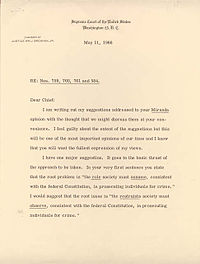
Justice Brennan'south comments on the Miranda decision.
Warren also pointed to the existing procedures of the Federal Agency of Investigation (FBI), which required informing a suspect of his right to remain silent and his right to counsel, provided gratis of charge if the suspect was unable to pay. If the suspect requested counsel, "the interview is terminated." Warren included the FBI'due south four-page brief in his opinion.[9]
Yet, the dissenting justices accused the majority of overreacting to the trouble of coercive interrogations, and anticipated a drastic outcome. They believed that, one time warned, suspects would ever demand attorneys, and deny the police the ability to gain confessions.
Clark'southward concurrence in role, dissent in part [edit]
In a divide concurrence in part, dissent in part, Justice Tom C. Clark argued that the Warren Court went "besides far likewise fast." Instead, Justice Clark would utilise the "totality of the circumstances" test enunciated by Justice Goldberg in Haynes v. Washington. Nether this examination, the court would:
consider in each case whether the law officer prior to custodial interrogation added the warning that the suspect might have counsel present at the interrogation and, further, that a court would appoint one at his asking if he was too poor to employ counsel. In the absence of warnings, the burden would exist on the State to prove that counsel was knowingly and intelligently waived or that in the totality of the circumstances, including the failure to give the necessary warnings, the confession was clearly voluntary.
Harlan's dissent [edit]
In dissent, Justice John Marshall Harlan II wrote that "zip in the letter or the spirit of the Constitution or in the precedents squares with the heavy-handed and one-sided action that is so precipitously taken by the Courtroom in the name of fulfilling its constitutional responsibilities." Harlan closed his remarks by quoting former Justice Robert H. Jackson: "This Courtroom is forever calculation new stories to the temples of ramble law, and the temples take a way of collapsing when one story also many is added."
White'southward dissent [edit]
Justice Byron White took consequence with the court having announced a new constitutional correct when it had no "factual and textual bases" in the Constitution or previous opinions of the Courtroom for the rule announced in the opinion. He stated: "The proposition that the privilege against cocky-incrimination forbids in-custody interrogation without the warnings specified in the majority opinion and without a clear waiver of counsel has no pregnant support in the history of the privilege or in the language of the Fifth Subpoena." White did not believe the right had whatsoever footing in English mutual police force.
White further warned of the dire consequences of the majority stance:
I accept no want whatsoever to share the responsibility for whatever such touch on the nowadays criminal process. In some unknown number of cases, the Court's rule will return a killer, a rapist or other criminal to the streets and to the environment which produced him, to repeat his crime whenever it pleases him. Equally a consequence, there will non exist a gain, but a loss, in man dignity.
Subsequent developments [edit]
Retrial [edit]
One witness was Twila Hoffman, a woman with whom Miranda was living at the time of the offense; .[10] [11] Miranda was convicted in 1967 and sentenced to serve 20 to 30 years.[11] The Supreme Court of Arizona affirmed,[12] and the United States Supreme Court denied review.[13] Miranda was paroled in 1972. Afterward his release, he returned to his erstwhile neighborhood and made a small living autographing police officers' "Miranda cards" that contained the text of the alarm for reading to arrestees. Miranda was stabbed to decease during an argument in a bar on January 31, 1976.[xiv] A doubtable was arrested, but due to a lack of evidence against him, he was released.[fifteen]
Another three defendants whose cases had been tied in with Miranda's – an armed robber, a stick-up homo, and a banking company robber – either made plea bargains to lesser charges or were found guilty again despite the exclusion of their confessions.[16]
Reaction [edit]
The Miranda decision was widely criticized when it came down, equally many felt information technology was unfair to inform suspected criminals of their rights, as outlined in the decision. Richard Nixon and conservatives denounced Miranda for undermining the efficiency of the constabulary, and argued the ruling would contribute to an increment in offense. Nixon, upon becoming President, promised to engage judges who would reverse the philosophy he viewed as "soft on criminal offense." Many supporters of police enforcement were angered by the decision's negative view of constabulary officers.[17]
Miranda alert [edit]
Later the Miranda decision, the nation'south police departments were required to inform arrested persons or suspects of their rights nether the ruling prior to custodial interrogation or their answers would not be admissible in courtroom.[18] Such information is called a Miranda warning. Since it is usually required that the suspects be asked if they sympathise their rights, courts accept as well ruled that any subsequent waiver of Miranda rights must exist knowing, intelligent, and voluntary.[19]
Many American police departments have pre-printed Miranda waiver forms that a doubtable must sign and date (after hearing and reading the warnings again) if an interrogation is to occur.[20] [21]
Information from the FBI Uniform Criminal offence Reports shows a abrupt reduction in the clearance rate of violent and belongings crimes after Miranda.[22] However, according to other studies from the 1960s and 1970s, "reverse to popular belief, Miranda had little, if any, result on detectives' power to solve crimes."[11]
Legal developments [edit]
The federal Coach Crime Control and Safe Streets Deed of 1968 purported to overrule Miranda for federal criminal cases and restore the "totality of the circumstances" test that had prevailed previous to Miranda.[23] The validity of this provision of the police force, which is yet codified at 18 U.s.a.C. § 3501, was not ruled on for another 30 years because the Justice Department never attempted to rely on information technology to support the introduction of a confession into evidence at any criminal trial.[ citation needed ]
Miranda was undermined by several subsequent decisions that seemed to grant exceptions to the Miranda warnings, challenging the ruling's claim to be a necessary corollary of the Fifth Amendment. The exceptions and developments that occurred over the years included:
- The Court found in Harris v. New York, 401 U.S. 222 (1971), that a confession obtained in violation of the Miranda standards may withal be used for purposes of impeaching the defendant's testimony; that is, if the defendant takes the stand at trial and the prosecution wishes to introduce the defendant'southward confession equally a prior inconsistent statement to set on the defendant's credibility, the Miranda belongings will non prohibit this.
- The Court found in Rhode Island v. Innis, 446 U.S. 291 (1980), that a "spontaneous" statement made by a defendant while in custody, even though the accused has not been given the Miranda warnings or has invoked the right to counsel and a lawyer is not still present, is admissible in prove, as long equally the statement was not given in response to police questioning or other deport by the police likely to produce an incriminating response.
- The Court institute in Berkemer v. McCarty, 468 U.S. 420 (1984), that a person subjected to custodial interrogation is entitled to the benefit of the procedural safeguards enunciated in Miranda, regardless of the nature or severity of the criminal offense of which he is suspected or for which he was arrested.
- The Court found in New York five. Quarles, 467 U.S. 649 (1984), that in that location is as well a "public safety" exception to the requirement that Miranda warnings exist given before questioning; for example, if the defendant is in possession of information regarding the location of an unattended gun or there are other similar exigent circumstances that require protection of the public, the defendant may exist questioned without warning and his responses, though incriminating, will exist admissible in evidence. In 2009, the California Supreme Court upheld the conviction of Richard Allen Davis, finding that the public-condom exception applied despite the fact that 64 days had passed from the disappearance of the girl later plant to be murdered.[24]
- The Court found in Colorado 5. Connelly, 479 U.S. 157 (1986), that the words "knowing, intelligent, and voluntary" hateful but that suspects reasonably appear to empathise what they are doing and are not being coerced into signing the waiver; the Court ruled that it is irrelevant whether the suspect may actually have been cognitively or mentally impaired at the fourth dimension.
United States v. Garibay (1998) clarified an of import thing regarding the scope of Miranda. Defendant Jose Garibay barely spoke English and conspicuously showed a lack of understanding; indeed, "the agent admitted that he had to rephrase questions when the defendant appeared confused."[25] Because of the defendant'due south depression I.Q. and poor English-linguistic communication skills, the U.S. Court of Appeals ruled that it was a "clear error" when the district court found that Garibay had "knowingly and intelligently waived his Miranda rights." The court investigated his waiver and discovered that information technology was missing all items for which they were looking: he never signed a waiver, he only received his warnings verbally and in English, and no interpreter was provided although they were available. With an opinion that stressed "the requirement that a defendant 'knowingly and intelligently' waive his Miranda rights," the Court reversed Garibay's conviction and remanded his case.[26]
Miranda survived a strong challenge in Dickerson v. United states of america, 530 U.S. 428 (2000), when the validity of Congress's overruling of Miranda through § 3501 was tested. At issue was whether the Miranda warnings were actually compelled by the Constitution, or were rather merely measures enacted every bit a matter of judicial policy.[ citation needed ] In Dickerson, the Courtroom, speaking through Chief Justice Rehnquist, upheld Miranda 7–2 and stated that "the warnings have go part of our national culture". In dissent, Justice Scalia argued that Miranda warnings were not constitutionally required. He cited several cases demonstrating a bulk of the and then-current courtroom, counting himself, and Justices Kennedy, O'Connor, and Thomas, also every bit Rehnquist (who had just delivered a contrary opinion), "[were] on record as assertive that a violation of Miranda is not a violation of the Constitution."[ commendation needed ]
Over time, interrogators began to devise techniques to laurels the "letter" simply not the "spirit" of Miranda.[ citation needed ] In the instance of Missouri v. Seibert, 542 U.Due south. 600 (2004), the Supreme Court halted one of the more controversial practices. Missouri constabulary had been deliberately withholding Miranda warnings and questioning suspects until they obtained confessions, then providing the warnings, getting waivers, and eliciting confessions again. Justice Souter wrote for the plurality: "Strategists dedicated to draining the substance out of Miranda cannot accomplish by grooming instructions what Dickerson held Congress could not practise by statute."[27]
Berghuis v. Thompkins (2010) was a ruling in which the Supreme Courtroom held that a doubtable's "ambiguous or equivocal" statement, or lack of statements, does not mean that law must end an interrogation.[28] At least one scholar has argued that Thompkins effectively gutted Miranda. In The Right to Remain Silent, Charles Weisselberg wrote that "the majority in Thompkins rejected the fundamental underpinnings of Miranda five. Arizona'southward prophylactic rule and established a new one that fails to protect the rights of suspects" and that
But in Thompkins, neither Michigan nor the Solicitor General were able to cite any conclusion in which a courtroom found that a doubtable had given an implied waiver subsequently lengthy questioning. Thompkins persevered for almost three hours before succumbing to his interrogators. In finding a waiver on these facts, Thompkins gives us an implied waiver doctrine on steroids.[ii]
Effect on police force enforcement [edit]
Miranda 's impact on police force enforcement remains in dispute. Many legal scholars believe that police take adjusted their practices in response to Miranda and that its mandates have not hampered police investigations.[29] Others argue that the Miranda dominion has resulted in a lower rate of confidence,[30] with a possible reduction in the charge per unit of confessions of between four and 16 percent.[31] Some scholars contend that Miranda warnings accept reduced the charge per unit at which the police solve crimes,[32] while others question their methodology and conclusions.[33]
In pop civilization [edit]
Miranda is mentioned, along with Escobedo v. Illinois, in the movie Dirty Harry, as well as in season 5, episode fourteen of Kojak, entitled "Mouse," and the Miranda warning itself is also mentioned in countless moving-picture show and Television crime dramas and thrillers.
Meet also [edit]
- United States constitutional criminal process
- List of criminal competencies
- List of United States Supreme Court cases, volume 384
- Miranda warning
- Schmerber 5. California
- Stansbury 5. California
- R. v. Hebert
- R. five. Brydges
References [edit]
- ^ Saltzburg & Capra (2018), p. 761.
- ^ a b Charles Weisselberg and Stephanos Bibas, The Right to Remain Silent, 159 U. Pa. L. Rev. PENNumbra 69 (2010), Available at: http://scholarship.law.berkeley.edu/facpubs/2181 (Retrieved May 2, 2016)
- ^ confessed to both, simply was not asked to and did not write downwardly his confession to the robbery. He was separately tried and convicted of the robbery and sentenced to 20 to 25 years of imprisonment. This crime, trial, and sentence is separate from the rape-kidnapping case appealed to the Supreme Court.
- ^ Michael Due south. Lief and H. Mitchell Caldwell "'Y'all Have the Right to Remain Silent,'" American Heritage, August/September 2006.
- ^ Miranda'south oral confession in the robbery case was also appealed and the Arizona Supreme Court too affirmed the trial decision to admit it in Land 5. Miranda, 401 P.2d 716. This case was non office of the appeal to the Supreme Court of the United States.
- ^ Oliver, Myrna (September 12, 2002). "John P. Frank, 84; Chaser Won Key Decision in 1966 Miranda Case". Los Angeles Times . Retrieved May 12, 2017.
- ^ LaFave et al. (2015), § half-dozen.v(b).
- ^ Syllabus to the U.S. Supreme Court determination in Miranda v. Arizona, property ane.(d).
- ^ Willing, Richard (June x, 2016). "The right to remain silent, brought you by J. Edgar Hoover and the FBI". The Washington Post.
- ^ State v. Miranda, 104 Ariz. 174, 176, 450 P.2d 364, 366 (1969).
- ^ a b c Lief, Michael S.; H. Mitchell Caldwell (Aug–Sep 2006). "You Take The Right To Remain Silent". American Heritage. Archived from the original on 2009-02-06. Retrieved 2011-08-24 .
- ^ State v. Miranda, 104 Ariz. 174, 450 P.second 364 (1969)
- ^ 396 U.South. 868 (1969).
- ^ "Miranda Slain; Chief Figure in Landmark Suspects' Rights Case". The New York Times. February 1, 1976. Retrieved May 12, 2010.
- ^ Charles Montaldo, Miranda Rights and Warning: Landmark Case Evolved from 1963 Ernesto Miranda Abort, about.com; accessed xiii June 2014.
- ^ "The Law: Communicable Upwardly with Miranda". Time. March three, 1967. Retrieved April ix, 2020.
- ^ "The Miranda Decision: Criminal Wrongs, Citizen Rights". The Washington Postal service. August 7, 1983. Retrieved April ix, 2020.
- ^ "What Are Your Miranda Rights". ExpertLaw. 2017-05-01. Retrieved 2017-05-01 .
- ^ Come across, e.g., "Colorado v. Bound, 479 U.S. 564, 856-57 (1987)". Google Scholar . Retrieved eighteen March 2018.
- ^ Edwards, H. Lynn (1966). "The Furnishings of Miranda on the Work of the Federal Bureau of Investigation". American Criminal Law Quarterly. 159: 160–161. Retrieved 18 March 2018.
- ^ "Miranda Waiver" (PDF). Academy Police Section. University of North Alabama. Retrieved 18 March 2018.
- ^ "Handcuffing the Cops: Miranda'due south Harmful Effects on Law Enforcement | NCPA". 2015-05-xviii. Archived from the original on 2015-05-18. Retrieved 2016-09-28 .
{{cite web}}: CS1 maint: bot: original URL status unknown (link) - ^ "Cite Miranda And Get Gratuitous". Sarasota Journal. 31 May 1968. p. seven.
- ^ People vs. Davis, S056425.
- ^ Einesman, Floralynn (1999). "Confessions and Culture: The Interaction of Miranda and Variety". Journal of Criminal Law and Criminology. ninety (one): 1–48 [p. 41]. doi:10.2307/1144162. JSTOR 1144162. NCJ 182327.
- ^ United states of america Court of Appeals, Ninth Circuit (May 5, 1998), Usa of America, Plaintiff-Appellee, v. Jose Rosario GARIBAY, Jr., Defendant-Appellant. No. 96-50606. , retrieved Feb 15, 2017
- ^ "Missouri v. Seibert, section VI". Archived from the original on May 25, 2009. Retrieved 2010-05-07 . Hosted by Duke University School of Constabulary.
- ^ Berghuis 5. Thompkins, 560 U.S. 370 (2010).
- ^ Duke, Steven B. (2007). "Does Miranda Protect the Innocent or the Guilty?". Chapman Police Review. 10 (3): 551. Retrieved 14 January 2020.
- ^ Cassell, Paul G. (19 August 2011). "Miranda'due south Social Costs: An Empirical Reassessment". Northwestern University Law Review. 90 (2). Retrieved 14 January 2020.
- ^ Fairness and effectiveness in policing : the evidence. National Academies Press. 2004. ISBN0309084334.
- ^ Cassell, Paul G.; Fowles, Richard (2017). "Nevertheless Handcuffing the Cops: A Review of Fifty Years of Empirical Evidence of Miranda's Harmful Effects on Law Enforcement". Brigham Immature Police force Review. 97: 685. Retrieved fourteen January 2020.
- ^ Alschuler, Albert W. (2017). "Miranda's Fourfold Failure". Boston Law Review. 97: 649. Retrieved 14 January 2020.
- LaFave, Wayne R.; State of israel, Jerold H.; King, Nancy J.; Kerr, Orin S. (2015). Criminal Procedure (4th ed.). St. Paul: West Academic Publishing. OCLC 934517477.
- Saltzburg, Stephen A.; Capra, Daniel J. (2018). American Criminal Process: Cases and Commentary (11th ed.). St. Paul: West Bookish. ISBN978-1683289845.
Further reading [edit]
- Bakery, Liva (1983). Miranda: Offense, law, and politics . New York: Atheneum. ISBN978-0-689-11240-ix.
- Kassin, Saul One thousand.; Norwick, Rebecca J. (2004). "Why People Waive Their Miranda Rights: The Power of Innocence". Law and Human being Behavior. 28 (2): 211–221. CiteSeerX10.1.one.334.983. doi:10.1023/B:LAHU.0000022323.74584.f5. PMID 15141779. S2CID 18578057.
- Levy, Leonard W. (1986) [1969]. Origins of the Fifth Subpoena (Reprint ed.). New York: Macmillan. ISBN978-0-02-919580-two.
- Soltero, Carlos R. (2006). "Miranda five. Arizona (1966) and the rights of the criminally defendant". Latinos and American Law: Landmark Supreme Court Cases. Austin, TX: University of Texas Press. pp. 61–74. ISBN978-0-292-71411-3.
- Stuart, Gary L. (2004). Miranda: The Story of America'south Correct to Remain Silent. Tucson, Arizona: University of Arizona Press. ISBN978-0-8165-2313-9.
External links [edit]
-
 Works related to Miranda v. Arizona at Wikisource
 - Text of Miranda v. Arizona, 384 U.S. 436 (1966) is available from:Cornell CourtListener Findlaw Google Scholar Justia Library of Congress Oyez (oral argument audio)
- "Supreme Court Landmark Example Miranda v. Arizona" from C-SPAN's Landmark Cases: Celebrated Supreme Court Decisions
- An online publication titled "Miranda five. Arizona: The Rights to Justice" containing the most salient documents and other primary and secondary sources from the Law Library of Congress
Source: https://en.wikipedia.org/wiki/Miranda_v._Arizona
0 Response to "what change to policing resulted from miranda v. arizona"
Post a Comment