Walking to the Wild Once Again
We took a break from our regular walks to sit down down and reverberate on previous walks. Some of the children were keen to depict their ain 'map' of the places we had walked and and then we prepare aside time to do some map cartoon.
A number of the children drew winding pathways dotted with plants and animals – reminders of things they had seen along the way.
A few recalled the various $.25 of 'treasure' nosotros had establish – such as the bottle with a message in it – and this soon led to cartoon maps with all kinds of hidden treasures.
As if prompted by the nautical theme of treasure maps and sunken ships, some recalled the wooden remains they had once spotted submerged in the lake – their own 'Titanic' discovery. All at in one case the stories began, and the drawings became non so much pictures 'of' things, equally parts of the story itself. The force of an imaginary storm was conjured up on i child's page, and the outline of the gunkhole slowly disappeared from view nether layers of dark, swirling air current and rain. He explained as he drew:
This is the black storm
The red is the fire running about in the h2o.
The storm is putting out the burn.
Meet how dark it's getting.
The h2o is putting the burn down out.
Several children took up this form of 'tempest cartoon', recounting stories of people going overboard, ships existence broken to pieces and all thing reduced to nothing in the path of the dark tempest.
Every bit the imaginary storms abated, the drawings came to an end. These did not then much offer finished representations of the place, but instead a compelling reminder of the liveliness of weather, place, people and the ways these are so often flung together. In these drawings, I was reminded of Doreen Massey'south work and her hope that we might liberate our idea of space as something that is far from 'closed' or 'static' or able to exist represented on the 'apartment horizontality of the page', just rather to come up to understand it as something lively or ongoing. Place in this sense can exist thought of as an 'result'. Every bit Massey says:
What is special near identify is non some romance of a pre-given collective identity or of the eternity of the hills. Rather, what is special about place is precisely that throwntogetherness, the unavoidable challenge of negotiating a here-and-now … and a negotiation which must take place inside and between both human and non-homo (Massey, 2005, 140).
The children'southward drawings seemed to somehow bridge the divide between representation and event, opening an imaginary and lively space through a cartoon in which they were at the same time fatigued by the atmospheric condition.
References
Massey, D. (2005) For Space, Sage publishing, London.
Despite the overnight rain and a common cold mean solar day that invited us to rug up in coats and beanies, the children seemed to sense a shift towards warmer atmospheric condition. Every bit nosotros ventured out, the children talked to each other about this invisible yet somehow discernible change in the air: 'Information technology'due south like Jump merely not Spring all the same'.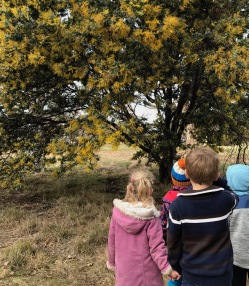
The presence of a flowering Acacia nearby confirmed this idea. Though with this besides came reminders of the bodily discomforts that might lie ahead for some. 'That's a Wattle' one kid explained. 'My mum'due south allergic to pollen'.The vibrant yellow flowers also prompted a reminder of bees and how they would shortly be buzzing effectually to 'bring the pollen home and brand it into honey'. 
Rabbits darted off through the grass, and the damp world was spotted with the scratchy beginnings of many rabbit holes.

All of these small awakenings seemed to be somewhat communicable, and the children's lively movements echoed the seasonal change in the air. The children all had a definite spring in their step, walking and running at times with heightened energy and anticipation as to what they might notice.
And they found many things. A bone that looked scissors, some other bone that was like a ring and a pine cone that could be a hat.

These interactions between the children and the various objects they constitute were total of playful possibilities. The children seemed to invite their home worlds into this place, and at the aforementioned time strengthened their connection to this place as somewhere they also felt 'at habitation'.
A hazard meeting with a dog chosen Lucky also reminded us that the 'wildlife' here at times includes more domesticated companion animals. The children were reluctant to say bye when information technology was time for the friendly dog to continue on its walk.

The children besides saw the lively traces of other creatures in various objects. One child picked upwardly a rotting log and noted it was total of 'holes' and even some 'poo'. Every bit the children pondered on these markings, they shared ideas:Somebody pecked in information technology. A bird. A woodpecker?
The edges of the lake were slippery from the recent rain, but this didn't deter the children from their lakeside explorations.
Equally on previous walks, bits of rubbish were spotted again floating in the h2o and became the subject of some intrigue
A xanthous bottle elevation caught i girls' eye, and she called out 'Golden money!'. Soon others gathered around: 'Where'due south the gilt coin. In that location! We need gilded money. But how do we catch it?'. A flurry of splashing sticks before long ensued as the children tried to entreat the bottle top to come up inside reach.
Despite all these efforts, the bottle elevation gradually moved further away, and children before long gave upwards on this mission.
More luck ensued with a canteen floating closer to the edge, this fourth dimension inside reach. Still, a further surprise was in shop, for on closer inspection we could see that the bottle had a message in it!'Pirates for sure', one kid exclaimed. 
The children retrieved the bottle and tried in vain to open up it, each taking turns. 'Too slippery. Also slippery as well. Also hard. Let me attempt'. The wet surface of the glass fabricated it impossible to grip, and twisting off the chapeau was only likewise difficult.

Resigned, the children placed the bottle back at the water's edge 'Perchance we weren't supposed open up it.' One child remembered wooden planks of the 'Titanic' from a previous walk and thought 'Perchance information technology came from the Titanic'.
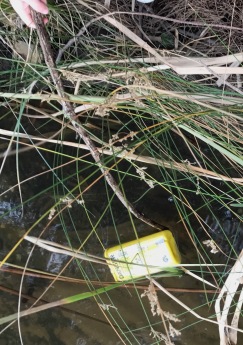
Somewhat ominously another discarded container floating nearby was marked 'Danger' and nosotros decided information technology was fourth dimension to leave our explorations of the lakeside for the day.
On reflection, information technology was surprising how even inside these small encounters, the children become enlightened of the complex intermingling flows of water and rubbish, evident for example in their musings on how a piece of rubbish might move from 1 part of the lake to some other, or in their attempts to reach a piece of rubbish merely to sentry it swirl closer and so move away again. The children seemed to examination and as well recognise their own limits in trying to excerpt rubbish from its watery path. In these interactions we all witnessed some of the human and non-human forces at play in the possible travels and trajectories of discarded human litter.
There were no surprises on this walk. Instead, the children retraced their steps, recalling events associated with sites they had visited previously, reminding the states that identify is a strong repository of retentivity.
Every bit usual, the children looked for interestingly-shaped bones at the Ngaraka Shrine and tried to identify them. Nosotros had our regular discussion most shrines being places for remembering, and the children noted, as before, that this shrine is the identify to remember 'the kangaroos that have died' and 'the Ancient people that were here start'.A couple of children set almost constructing their ain mini-shrine out of bones – a shrine within a shrine.


Equally we headed off downwards the colina they searched for the possum tail they had found on the last walk at the 'big teeth' sculpture. Information technology was nowhere to be seen, so they abandoned the search and chop-chop scrambled upwards the stone wall, pausing briefly, as they unremarkably do, to inspect the rabbit burrows before heading off to the lakeside.
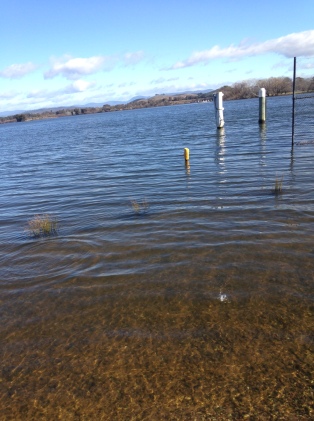

Dissimilar on previous walks, there were no waterbirds to exist seen this time. In their absence, the children engrossed themselves playing with sticks and stones. They used the sticks to splash the water and prod the footling pebbles at the water's edge. They threw the pebbles into the water, trying to propel them out as far out as they could. The concentric rings that spread out from the impact of stones on water became the marker of a successful throw. The water afforded familiar patterns of response to their stick and stone incursions.

Sifting through the multi-coloured pebbles, the children were keen to find some 'precious stones' and 'jewels'. The potential crimson turned out to be a piece of cerise plastic, 'maybe from a wheel light?', and on closer inspection, a wait-alike 'emerald' was simply a worn fragment of a broken dark-green bottle.

 A large shiny object, which looked a bit like a large polish rock from a distance, turned out to exist a plastic bag total of sand. These rogue pieces of waterside trash prompted the children to reflect upon the hazards that plastics pose to h2o-birds and fish – 'they tin can die from eating the plastic'. The conversation was a repeat from previous visits to the lakeside and a reference to knowledge gained in the classroom. The children were conspicuously grappling with what they might practise with this agonizing data. And once once again, they faced the dilemma of wanting to protect the wildlife past removing the plastic from the beach, simply at the same time remembering that they are not supposed to choice up trash.
[Walk – 22 June 2017]
The children were smashing to head east of the Center again, this time to explore the south cease of the cove.
On the style, they began discussing the difference between this lake and the sea. Some thought there might be sharks in the lake; others disagreed because it wasn't the bounding main. The sea was fabricated of salt water one suggested, but equally another pointed out 'there'south white dots in it [the lake] so it is salt water'.
 Ane of the get-go things the children noticed was the rubbish dotted forth the edge of the lake. This was cause for concern. They were conscious that h2o creatures are harmed by eating homo droppings.
There'southward lots of rubbish. A turtle might think the rubbish is jelly fish and eat information technology.
Await. There's rubbish in the water. The fish will be sick if they consume information technology. There'south an quondam bottle.
While the children could easily made a connexion between the rubbish and the well-being of various water creatures, they were less certain most what they should do about information technology. Some wanted to pick the rubbish upwards and take it back to the Eye. Others remembered they had been told not to pick upward rubbish (in example it was unsafe to affect). They stood for some time pondering this dilemma, looking at each piece in turn – straws, bits of plastic and drinking glass bottles.
In the stop, they settled with lifting some bits out of the water with sticks and putting information technology out of accomplish of the gentle lapping waves at the h2o's border.At least information technology was out of harms way for the fish.
While the children knew this was a lake, there were things that felt a piddling out of place. We spotted a bird, and as one child exclaimed 'It'due south a seagull!'. The presence of seagulls this far inland was indeed a mystery.


The remains of a large carp hanging in a tree was another sighting that was difficult to explicate: 'Perhaps a bird caught that fish and ate the fish and then hanged it at that place.'
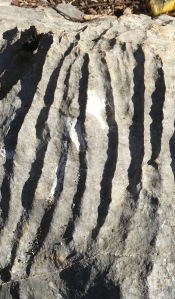 While some children studied the fish, others were distracted by deep vertical marks in a limestone stone nearby.
Thoughts of wild animals immediately came to mind.
'I wonder what sort of animal they ca me from. Maybe one with really strong claws made it.'
The sunlight offered new types of glimpses into the lake. Under the surface, we could run across fallen trees and the glinting reflections of stones. The children could just make out the shape of a tree: 'It's inside the water.  Maybe it was too old and then it fell all the fashion down. It fell into the h2o and the stop is correct over at that place . I encounter leaves. I tin see copse. What's that under the h2o? It looks similar gilt.

Every bit we reached the furthermost point of our walk, the children stumbled on a discover that once more reminded them of the body of water.  On spotting an old wooden boat ramp now submerged at the lake's edge, they began speculating on whether information technology could be a ship wreck. 'I retrieve that's an old ship. Because ships take windows.'
 Reaching out with their sticks to feel the wooden planks, some children told us: 'it feels hard and a scrap viscous in there. It'south likewise very splashy.'
They then called out: ' Come here everyone we establish an old boat.' One imaginative child added: 'I think that people died inside. I think information technology is from the Titanic. The Titanic is very long. Possibly the rest of it is underneath.'

All the children gathered around. It was wet and slippery at the lake's edge, and they had to work out how to get as close equally possible without slipping in. They reassured each other not to worry about getting a petty moisture: 'The lord's day tin dry out you.' and 'I tin can see the sunday reflecting on the water.'
Nosotros prepare off dorsum to the Centre with a few sodden shoes and socks, but much excited talk about the possible fate of the sunken transport.
[Walk – 8 June 2017]
The intrigue with the kangaroo basic at the Ngaraka Shrine continues. Today the children tried to imagine how the bones might fit together. One child constitute several bones of a similar shape, and comparison the basic to his own body, he observed: I recollect it's a human knee os. Permit's take a await at this one.
Others looked more than closely into the decomposable bones, intrigued as to what might be inside: 'At that place'southward a big hole. There's sand inside.' 
Long after some of the others had moved on, couple of children lingered nether the Shrine, hesitant to go out.

Eventually nosotros did keep, the children stopping here and there at patches of soft orange and ruby-red globe only made visible by the avid digging of the rabbits.
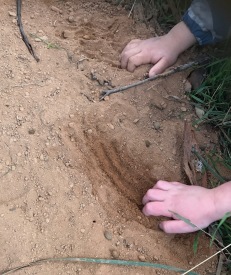
On our previous walks, the children had gently touched the soft earth, feeling its texture. Today, they seemed more intent on using their hands every bit rabbit claws. They furiously scratched at the world to simulate rabbit-claw digging marks.

Moving on from the familiar bones and rabbit-clawed diggings, our walk took a new turn.  The children gravitated to a large landscape sculpture they telephone call 'The Teeth'. They spent much fourth dimension squeezing their bodies in and out between the vertical jaw-like structure.
All of this 'teeth' activity was of a sudden interrupted past a puzzling and slightly gruesome find. Lying on the ground almost the sculpture was a single possum tail.

For some time, the children stood around the tail, keeping slightly dorsum every bit if not sure what to expect; some thinking the tail might still exist live. Ane child pondered: I retrieve the front of information technology died. And the back is still alive.
But the tail remained still. Emboldened by its inertness, one child picked up a stick to prod information technology. Others cautioned: It's a possum tail. Don't impact that. It could exist a poison tail. Somewhen, the other children as well decided that it might exist safe to prod, and one by i they all gear up of searching for prodding sticks: 'I'1000 going to find a stick. Me too.'
Using their implements, the children reached out and gently prodded the tail, checking for life and feeling its texture.
'Information technology's not live. It's fluffy.' … 'It might be a baby possum. Maybe this is the mummy of the babe.'
'Only lift it. Don't be scared.' … 'Yuk. Yuk. Leave information technology in that location.'
'There's something spiky on information technology. It's simply the prickles.'
The mood was sombre as we tried to work out what might have befallen the possum. 'Poor possum', the children said.
One child recalled a cadger [skink] that he had one time seen lose its tail, and explained: 'When the tail came off it was moving and the cadger ran away.' This immediately prompted a more hopeful idea: 'Maybe the tail came off the possum and the possum ran abroad.' On this note, nosotros headed dorsum to the Middle, leaving the tail lying next to 'the teeth' and at the whim of the elements and other creatures who live in this place.
On the walk back, one of the children reminded u.s.a. of the king parrots she had seen feeding on the berries. As on other walks, looking at birds always poses a detail dilemma – you lot demand to get shut to take a look, but the closer you become, the higher the chance the birds will wing abroad.  The children are constantly navigating this man-bird territory – pausing, 'shhing' and tiptoing when they spot a bird – and and so sighing with thwarting when the bird flies away, peradventure also grappling with a niggling sensation that our presence was in some way responsible for the bird moving on from its feeding basis.
[Walk – 11 May 2017]
At the offset of our walk, one child produced a hand drawn map. This volition show us 'where to become' she declared. 
We fix off via the back gate – the contrary way to usual. The children presently realised that the Shrine, which we commonly visit first, was nowhere to be seen. The search for the Shrine became an important mission – only how to go our bearings?
On the way we establish other homo-made maps and signposts that the children studied for clues; only in that location was null to help find the place we were looking for.
Luckily, at that place were signs in the landscape likewise.

One child looked for some time at the surrounding low hills, valleys and treed areas – so pointed out 'I think its that way because we always come up that mode from the Shrine'. He was spot on. We decided that if we kept walking up the hill, the Shrine would eventually come into view.
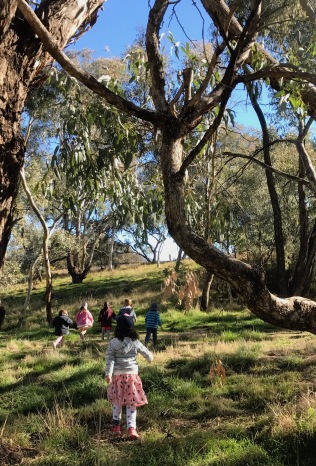
The children rushed off upwards the hill in anticipation of seeing the Shrine. They didn't get far before one stopped: 'I found something'! 'It is a teepee made of sticks.'

Shortly the children were exploring the surrounds, finding rabbit burrows and testing out the soft loose earth.
I saw a bunny. Hither is a bunny pigsty. There is another pigsty on this side!
This dirt. It's orange. It's the colour of an ant's nest. It's soft and cold and wet. In that location's some poo.

In the midst of all this activity, a reminder from 1 child: 'We need to continue going. We are already here (pointing to the map). Allow's get the Shrine. Information technology'southward upward the hill.'
Finally we arrived.

The children began eagerly tapping, scraping and turning over the now-familiar kangaroo bones in their easily.
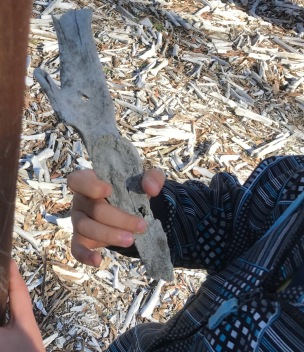
While some seem fascinated past the sound and feel of the basic, others looked to the shape of the bones. Sometimes, other animals would appear: 'This one looks like a sword fish. Run into it has a fin and a jaw.'
After some fourth dimension, the kid with the map said 'Now – let's get to the adjacent map. The next map has the rock wall.' As we passed over the rock wall the children wondered who might live in all the holes and crevices: 'Maybe a snake or a mouse. There's lots of holes hither.

Our final end was a large sunken dip in the landscape where the ground was covered in eucalypt bawl.  The children were intent on the 'crisis, crisis' sound underfoot as they walked along. This focus on the fallen tree debris soon revealed a number of big sticks – just the kind the children sometimes collect to take back to the Centre for their stick fence. Information technology didn't take long for each child to find a stick that they thought would exist perfect.
Navigating the way dwelling house begetting a collection of large sticks turned out to be quite a circuitous endeavour of child-stick manoeuvring.
[Walk – 27 Apr 2017]
We decided to walk to a different place today – to the lakeside cove due due east of the Centre. We'd noticed earlier that lots of water birds ofttimes hang out in this cove.
Every bit before long every bit nosotros arrived, the children spotted a pair of swans continuing on a grassed area past the lake's border. As we got closer, they noticed that there was something curiously different about i of the swans. Information technology only had one leg. This prompted much discussion: Swans don't have one leg. Swans accept two legs. They never, ever have one leg. Never, ever.

Despite having only one leg, the swan was perfectly balanced, occasionally pecking at the grass and at other times looking up at the inquisitive children. Taking all this in, the children started to wonder how the swan could have lost its other leg.
They started talking to the swans: 'Hello Hello' they chorused, slightly mimicking the swans' honking tones.

A couple of the children began to mimic the one-legged swan: I've got one leg. I tin balance on one leg. This quickly defenseless on, and shortly all of the children were trying to balance like the ane-legged swan.
In the midst of all the activity and excitement, the swan quietly put downwards its concealed second leg.Oh! Wait! It's got two legs! Information technology was hiding!It was as if the swan had tricked them. The children laughed and laughed.
As the swans started to walk towards the water, a couple of children noticed that one was scratching itself. This familiar action prompted them to further place with the swans' embodiment: 'I scratch when I get itchy' and 'I do besides, like when I get a mosquito bite'.
For the balance of our walk the swans paddled in the shallow h2o, following u.s. along the edge of the lake. Some of the children had noticed the swans pecking at grass before, and decided that grass must exist what swans similar to eat.
They kept feeding grass to the swans at regular points along our walk, explaining 'Looks like they want more dinner. They want more grass. The wind is blowing it away. They really like it. …. They are still following us.'
The gentle fall lord's day made united states all feel like staying outside a little longer. Some children lingered by the path, and afterward spending time finding an ideal 'writing' stick, started scratching images and words beyond the path. Some wrote their names while others drew pictures. I'chiliad drawing a automobile, one explained.


Initially, some expressed concern that the drawings would get rubbed out, perchance because ants, people, tractors might go over information technology. Yet, this was merely a fleeting concern. Quickly absorbed in the new activity, the children seemed content to work with the dirt path equally a temporary surface.
As we headed dorsum, the wind picked upwards bravado the dust around, already lightening the trace of the children'south markings on the footing.
[Walk – xiii April 2017]
We had promised a walk to the lakeside. Despite the children's determination to get to the lake, they still moved slowly, distracted by various sightings on the way. Many were not bad to point out changes they noticed since our final walk.

I kid rushed over to tell us that the Golden Orb spider was gone, and when nosotros looked closely we could run into that there was nothing more a few strands of web remains.
Others ran to the exact spot where tiny, delicate mushrooms had been spotted previously, only to exist disappointed to discover they had gone. Fungi nonetheless however featured on this walk, and it wasn't long earlier there were exclamations of 'look, expect mushrooms … lots of mushrooms!'. These mushrooms were mostly former and decaying, but nonetheless intriguing.

The sighting of a minor group of ducks well-nigh the water'due south edge drew the children's attention and hastened their inflow at the lakeside. Knowing how easily the ducks are frightened, they restrained their want to rush and tiptoed towards them. Once we arrived under the soft, drooping branches of the foreshore Casuarinas, the children settled in to the environs of the waters' edge. This was the first time this group of children had been to this part of the lakeside before. They were before long collecting feathers, navigating the slippery moss at the h2o'southward edge and 'fishing' with sticks – repeating the previous group's favourite patterns of activities.
Once once more, the combination of sticks and water seemed to offer a compelling invitation for the children to suspension and connect with underwater life.

Unexpectedly, a swan glided upwardly through the reeds and startled the children by coming within a few metres. This provoked much discussion: Look a swan! I think its looking for its babe.
Subsequently the walk, when the children recalled this take chances meeting, they responded with many excited 'swan' noises.
On our walks we have at times stumbled across a diversity of imperceptible, almost whimsical, human-made installations. This walk was no exception. As the children ran off calling to each other 'Come on, let's go to the next wood', they soon slowed as they entered the next stand of trees. Several curious artefacts came to light. One woven reed structure had been synthetic the same height equally the children'southward heads, so they could walk under it and imagine what it might exist. The children's speculative musings stretched from spiders to washing lines: Someone made this. Information technology looks like a spider web. … Maybe it is used for washing. It could be for washing.
As we headed back to the Heart, the children noticed an interesting tree. At kickoff, it wasn't quite clear why it was so hitting, and only on closer inspection did we observe it was 'half dead and half live'. 
Even more intriguing, in between the two trunks – i of which seemed clearly dead and the other alive – was a tertiary with some newly sprouting leaves. 
The children seemed to sense a certain ambiguity equally to whether the tree was living or dying as they reached out to gently touch the textures on the trunks. 
As a couple of the children climbed through the lower branches, another heeded 'Be careful. You might take all the skin off information technology'. This reference to the shedding bark captured a sense of vulnerability that seemed to surround this otherwise imposing and tall eucalypt.
The pelting that had been gently falling all morn was just starting to ease when we set off. We had a quick talk about what we might notice after the rain and someone suggested that the ants might non be out and about today, considering they prefer hot sunny days.
The children were bully to follow tell-tale signs of the contempo rain. Some pointed out the glistening droplets they saw lying in the folds of leaves. A couple of children stopped to brush the rain off one of the sculpture labels, using the h2o to clean it and make it shiny.
Someone suddenly noticed a glimpse of sunshine had only broken through the clouds overhead. 'Await, look behind you I tin find blue sky. I can run across bluish sky!'. Something was shifting.
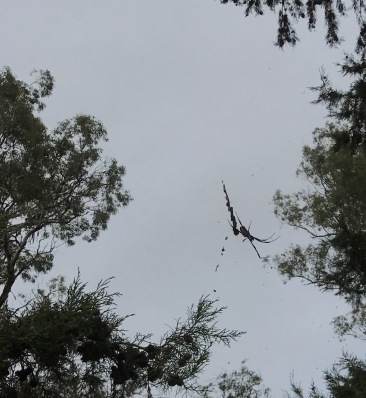
Raindrops, mysteriously suspended in air, drew the children's attention to a large spider web under the fir trees. They were captivated when they noticed a prominent gilded orb-weaving spider in the centre of the web. It was at perfect middle-level for them and they spent a long time closely inspecting the spider'south long stripy legs, the intricate forms of the web, and the strange leaf-like object that was trapped in it. The children were not sure if the spider was eating this trapped object of non.
They also noticed that there were mushrooms popping up through the footing. They were definitely not here concluding fourth dimension and the children surmised that it was the pelting that was making the mushrooms abound. When they looked around, they could see that in that location were quite a few unlike kinds.
One mushroom looked like it had been eaten and the children pondered on what creature might take done this – 'a rabbit' or 'a possum' were two suggestions.
The wet weather had fabricated the kangaroo bones at the Shrine 'a flake sticky'.  The old, weatherworn bones accept started to autumn apart when the children handle them. They always honey to rub the bones confronting the rusty metal frame to see the marks they make.
In the wet, the marks were more prominent than usual. On closer inspection, the children could meet that what looked similar white chalk was actually tiny fragments of soft bone stuck to the rust.
A fan-shaped nature-art installation in a clearing under a bush caught our eye. It was made of carefully arranged pinecones, bark and brightly covered leaves.
When questioned, one child thought 'a squirrel' might have made it. We talked about how squirrels don't alive in Australia. They fabricated another couple of tentative suggestions 'a possum?', 'a bunny rabbit?'. It was interesting that the children were keen to attribute the assemblage to a wild creature and no one mentioned information technology might be a human creation. Maybe it was their intent focus on exploring the wild animals in these bush-league surrounds, or perhaps a sign that the children's thoughts are not yet filtered through the western nature-culture split up that attributes cultural artifacts to humans lonely?
Past the end of our walk, the sun was well and truly on its style out. So was the birdlife. Of a sudden, our attention was directed upward as the air filled with birdsong and the condign-blueish heaven was punctuated with the flash of brightly coloured parrots.

The children were transfixed watching a flock of carmine rosellas darting through the treetops, and a pair of male monarch parrots eating in a nearby eucalyptus. A number of them recognised these parrots equally the ones they had seen at home or in their local park.

In continuity with the art-nature-culture assemblage that we had witnessed under the bush immigration, a pair of magpies perched high in the nearby bird-tree sculpture, started warbling their distinctive song.
On this walk, we were struck by just how much the weather influences the rhythms and movements of all life forms, including ours. And information technology illuminates our experiences. When it shifts, it makes such a difference, refocusing the children's attention from one thing to another – from the micro-worlds of raindrops on leaves and spiders webs, to the expansive bird-filled skies.

Most of the children are new to our walks this year. Every bit with last year's group, their initial task is to get to know the plants and animals that live in the grassy woodlands heritage park side by side to the Middle. Correct from the moment we prepare out, there was a palpable sense of eagerness and anticipation to exercise this.
We had barely arrived in the parklands, when they children started running to notice the wildlife, exclaiming 'there's a rabbit hole' and 'wait at the ants'. The ease with which the children shifted their attention from running through a large space, to focussing upon the micro-worlds of other lives around them was a pertinent reminder of how oftentimes it is the children who describe u.s.a. (adults) in to notice things that might otherwise escape our notice.
Co-ordinate to the routines we established last year, we stopped first at the Indigenous sculpture:Ngaraka: Shrine for the Lost Koori. We talked with the children about how the shrine can help u.s. to remember that others were here earlier the states, and that we walk on Aboriginal land, the land of the Ngunnawal people. The children repeated 'Ngunnawal' several times and seemed to enjoy the feel of the sound rolling off their tongues. It was every bit if repeating this word marked the beginnings of the processes of remembering.
The kangaroo bones scattered nether the shrine immediately drew the children'southward attention. Following the lead and routines of the two children from last year'south group, they picked upwardly the bones and began gently rubbing them up and downwardly the shrine's upright rusty poles. The marks left by the crumbling white bones reminded the children of chalk. 'Information technology's only like chalk' they remarked several times. Something about treatment the crumbling bones and the rhythm of the rubbing seemed to be as well role of the embodied process of remembering.
We noticed directly away that the ants were very active and spoke about why this might exist. Several children noted that this was considering it was sunny and we discussed how they like to come up out of their holes in the dry, warm weather. One kid wondered 'what do ants eat?', and for the rest of the walk we looked for clues that might provide an answer.

Under the copse, we found an ant that was carrying something circular in its pincers. One child suggested it might exist a little pebble. Eventually the emmet dropped information technology and nosotros picked it up and looked at information technology closely. It took a bit of handling and close scrutiny to work out that it was a seed of some sort. We also spotted ants crawling up a nearby demote, clustering around something scarlet and sticky. The children figured this was 'jelly' or 'jam', no incertitude left by a previous human company. From these observations, the children gleaned that ants like to swallow seeds and sweet things.

Earlier nosotros left, we had asked the children to look out for the plants and animals that live in this place. But they were really doing a lot more but looking. They were continually reaching out, touching and smelling the multitude of living things effectually them. They were getting a sense of the place in very hands-on, engaged and sensory ways.
1 child called us over to wait at a 'cactus' which on closer inspection turned out to be a prickly scotch thistle. 'Tin we touch on it?'several of them asked. They reached out gently, wanting to experience the spikiness of the plant while also taking care not to get hurt.
Nosotros stopped at a big sheltering peppercorn tree, which looked enticing and promised to be housing all kinds of living creatures. The branches were hanging depression to the footing, at kid's-eye level. I child immediately picked a leafage frond, rubbed it betwixt his fingers and so lifted it up to smell. At that place was lots of interest in what was making the stiff odor, and presently all the children were touching the low-lying leaves and spotting bunches of green 'berries' hanging amongst them. Afterward picking them, rubbing them between their fingers, inhaling the distinctively fiery smell and offering them effectually to each other – 'smell this one' and 'this one smells very strong too' – they came to the decision that they were not berries merely peppercorns. One of the educators pointed out that these berries might have been 'bush tucker' for the Ngunnawal people.
Venturing farther under the tree, the children spotted dried insect shells stuck to the lower trunk. 'Peradventure they're lobsters' one child speculated, but another corrected him 'no they're cicada shells'. Ane of the children who was very familiar with cicada shells told the others'you tin stick them on your t-shirt' but we decided that nosotros'd leave them there.
When asked what sounds they thought cicadas might make, the children spontaneously joined together in a loud chorus of loftier pitched buzzing sounds.
The children were only just starting to go a sense of the life in these grassy woodlands when it was fourth dimension to go dorsum. It was hard to get out, as there was and then much to more come across, touch, and smell. Nosotros headed back to the Middle with the promise that were many walks alee of u.s., when they would exist able to explore the rocks and the lakes edge that they could see at such an enticingly brusk distance away.
Source: https://walkingwildlifewildweather.com/
0 Response to "Walking to the Wild Once Again"
Post a Comment