How Do Students Get Good at Reading Words in Isoaltion When Practicing Cow
Other than size, how can you recognize a pupil in kindergarten? Maybe information technology's their energy, or perchance you see all of their smiles? For me, the sign is pointing equally they read, and pointing to the text is a reading behavior we talk a lot nigh. It is one THE signs of reading progress.

I am Carla from Comprehension Connexion, and I'thou excited to share literacy tidbits with y'all here on Classroom Tested Resources including information most Concept of Discussion. I am a reading specialist from Virginia in my 25th yr of instruction with grades K-five and creator of products for Comprehension Connectedness.This year, I am working primarily with fourth and fifth, still, today's post will be aimed at Kinders and Firsties. I will let you in on a undercover. I LOVE the primary grades. :-)

What is a Concept of Word?
So were yous a bit thrown off by the title, Edifice COW with Kinders? You may have wondered if y'all'd somehow clicked on a farming magazine by fault, but developing COW (Concept of Word) is a critical instructional need for our emergent readers to move along the reading continuum to existence existent readers.
How does Cow develop?
COW develops in stages, and beneath, yous can see the descriptors for each stage in development. If yous work with Pre-K, you may observe scribbles in writing progresses to random letters to maybe first sound. At the start of kindergarten, nosotros run into a wide range and have kids come with no alphabet knowledge to those who are kickoff to read some. Below, you'll see a brief description of the stages.
Undeveloped Concept of Give-and-take
1. Has left to right directionality, simply no discussion awareness. Writing looks like squiggles beyond folio.
2. Points along with stressed units (syllables or words, but does not differentiate). Writing begins to include some messages, but they are random.
3. Points to words and says syllables. Writing begins to include beginning sounds of words.
Rudimentary Concept of Word Development
The student is approaching the beginning reader stage when he/she:
4. Points to words and begins to self correct when he/she gets off track. Writing now includes beginning and ending sounds, but may non include vowels.
House Development of a Concept of Discussion
The student has reached the offset reader stage when he/she
5. Demonstrates accurate tracking of print. Writing includes space betwixt words and curt vowel words include get-go, middle, and ending sounds. The reader in the video below is not completely firm, but very close.
How Can Teachers Work to Develop Moo-cow
With Students?
.JPG) The first step with Concept of Word Instruction is to teach a poem y'all've chosen to the students orally and with pictures. They demand to take the poem memorized, and then that they tin can accurately lucifer the memorized words to the print they encounter. Teachers can use pictures that represent the text or manus motions with common nursery rhymes and finger plays. Recall, the focus is on connecting oral language to print.
The first step with Concept of Word Instruction is to teach a poem y'all've chosen to the students orally and with pictures. They demand to take the poem memorized, and then that they tin can accurately lucifer the memorized words to the print they encounter. Teachers can use pictures that represent the text or manus motions with common nursery rhymes and finger plays. Recall, the focus is on connecting oral language to print.
.JPG) What follows is the fun part for me! The best way to develop Moo-cow is by playing with words, sentences, and a large array of pointers. There are so many fun pointers available through the Dollar Tree. For spring, I have a few flyswatters with ladybugs and butterflies on them. The pointers in the greatest demand in my room are most definitely my light sabers, simply magic wands are very popular too. As you work with the poem, yous desire to striking on sightwords and beginning sounds with those who are prepare. With kids at the undeveloped/rudimentary stage, yous'll piece of work on the concept of space...white space betwixt words and spacing of messages to course word.
What follows is the fun part for me! The best way to develop Moo-cow is by playing with words, sentences, and a large array of pointers. There are so many fun pointers available through the Dollar Tree. For spring, I have a few flyswatters with ladybugs and butterflies on them. The pointers in the greatest demand in my room are most definitely my light sabers, simply magic wands are very popular too. As you work with the poem, yous desire to striking on sightwords and beginning sounds with those who are prepare. With kids at the undeveloped/rudimentary stage, yous'll piece of work on the concept of space...white space betwixt words and spacing of messages to course word.
.JPG)
When working with my Kinders on pointing, I place a touch point under each word. I discovered this tip when I downloaded freebies from Sparklebox.co.united kingdom . I downloaded brusque vowel word cards for a game that included a dot under each sound. I had an light bulb moment and thought why non utilise that strategy to Cow. Every bit nosotros go on to develop Moo-cow, I put my students more and more into leveled books. I continue to apply this strategy with projected books on Reading A to Z and with other powerpoint resource I've made. If you are a primary instructor, Reading A to Z is a subscription that is well worth the price. The projectable feature has been very benign to my students for modeling and practice, but in that location are many other resources for beginning readers available on the site. You lot can explore that further here in a blog post I wrote recently for Adventures in Literacy Land.
.JPG) Matching words in isolation to words in context is another activity that fosters an understanding of print. Teachers can use dissimilar fonts with the word cards. Using Dolch words with various games helps students to identify them in context likewise and helps students recognize when their tracking is off. Marie Clay refers to Concept of Word as "Reading the White Space", and this activity has helped my students recognize this. I model how to split up words by cut between them similar pulling apart puzzle pieces. In fact, we often take the pieces, mix them upwardly, and reorganize them to brand the individual words become the line of the verse form.
Matching words in isolation to words in context is another activity that fosters an understanding of print. Teachers can use dissimilar fonts with the word cards. Using Dolch words with various games helps students to identify them in context likewise and helps students recognize when their tracking is off. Marie Clay refers to Concept of Word as "Reading the White Space", and this activity has helped my students recognize this. I model how to split up words by cut between them similar pulling apart puzzle pieces. In fact, we often take the pieces, mix them upwardly, and reorganize them to brand the individual words become the line of the verse form.
Afterward we have worked a few days with the sentences strips and words in isolation, I transfer my students to the book grade. With the book form of the poems, I spend time on letter identification, sighword identification, using picture clues, and even comprehension. The children savour highlighting, battle, underlining, and mark with mini stickies features I inquire. We also mark by boxing around the letters by name and audio.
 With my students, I typically piece of work with a poem for a 3-5 days depending on the poem'due south difficulty. The last affair I exercise with my students is requite them the poem on a unmarried sail. We practice reading without the help of touch points, highlights, boxes, etc. I have them prepare the poesy folio for their keepsake book, and equally the year goes, the poems we use increase in difficulty. Our kindergarten teachers employ thematic teaching, and then the poems I cull to employ with my groups typically parallel what is happening in the regular classroom. I do not utilise the same poems in my room though because I try to provide them with new experiences to build upon skills that are developing in the classroom. Plus, new poems keep the learning fresh and fun.
The verse form used in this post is a freebie from my shop. If you lot'd like to add this poem to your Moo-cow collection, feel free to download your ain copy using the image below which shows what is included or click [here].

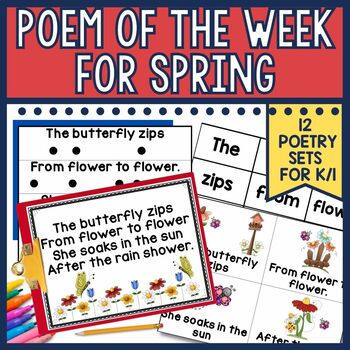
I also have a Fall, Winter, and Bound collection available in my shop. Each ready includes 12 poems that fit the season equally well as some that can exist used any time of yr. Hither is a preview of the Spring edition. Topics include leprechauns,Spring, Easter, ducks, farming, gardening, flowers, butterflies, frogs, Female parent's Day and Father'southward 24-hour interval, trees/reading, and weather.
 |
| $five.50 |
Cheers so much for visiting today. For additional poetry resources, I hope yous'll drop by [my web log] to catch Thematic Thursday, a weekly linky party I host. The theme this calendar week is poesy, and in the past few weeks, nosotros've explored insects, frogs, atmospheric condition and many other spring themes. I am thrilled to be part of this blog. The group has dandy posts coming for you lot on a variety of topics, so I hope yous stop dorsum often.

Source: https://www.classroomtestedresources.com/2015/04/building-cow-with-kinders-with-freebie.html
0 Response to "How Do Students Get Good at Reading Words in Isoaltion When Practicing Cow"
Post a Comment